
Apprentice-Master I
Project content
The Print Room’s Apprentice-Master cataloguing project started in spring 2022. The project is one of the catch-up initiatives that Musea Brugge is undertaking in the area of collection registration, subsidised by the Flemish Government. It follows the earlier grant-funded projects ‘Enriching Perspectives on Bruges’ and ‘Hub! From Depot to Digital Collection’.
The cataloguing project ‘Apprentice-Master: Figure Drawings from the Bruges Academy in Context (1757–1892)' has now been successfully completed with the support of the Flemish Government. The project began in spring 2022 with the cataloguing of figure studies made by students of the Bruges Academy in the period 1757–1892. The collection exhibition 'Practice Makes Perfect' marks the project’s conclusion. Moreover, all catalogued academic figure drawings, prints, and Jan Garemijn’s notebooks have been made accessible on the Musea Brugge collection page.

Catch-up in collection cataloguing
The aim of the grant project was to catalogue and make accessible the figure studies from the Print Room’s Academy sub-collection. Through detailed registration of this collection of drawings (877) and prints (138), the teaching practice of the 18th and 19th centuries was examined. The drawings were made by students at the Bruges Academy in the period 1757–1892, primarily as prize drawings produced for competitions. The subjects of the figure drawings reflect the three class categories of the period: drawing after prints, drawing after plaster sculptures and drawing from live models. Drawing media were limited to charcoal and black, white or red chalk on paper. In the elementary classes, students copied model prints: engravings and lithographs. Beginners learned to study the human form by imitating compositions by great masters. The idea was that a student could evolve into a master by drawing from ‘ideal’ examples, such as the visual language of classical sculpture or works by Charles Le Brun, Michelangelo and Raphael.
This approach continued in the higher classes: students progressed to drawing after casts of (often classical) sculptures and, in the advanced class, the live models adopted distinctly ‘academic’ poses.
Digital links across collections
Thanks to the detailed cataloguing and online publication of the figure drawings, relationships could be established between drawings and their model prints – both within our own holdings and in external collections. Research was undertaken to identify the prints copied. Over time, print series were dispersed and not always preserved intact. This complicated the process of recognizing the subject, the specific print and the print maker. Nevertheless, 171 of the 250 prints were identified. Matches were found with prints held at the Royal Academy of Fine Arts, Ghent and the Royal Library of Belgium, Brussels. At Musea Brugge’s request, these partner institutions catalogued their academic prints so that digital links could be created from our collections database to the objects in their collections. In this way, the drawings were, in effect, reunited with the instructional materials that once served as their models.


Deciphering Garemijn
Director Jan Garemijn kept a series of personal notebooks between 1765 and 1775, recording the day-to-day life of the Academy. As teacher of the life-drawing class, he also noted the poses used in lessons and competitions.
To decipher the eight notebooks in our collection – together more than 500 pages – we launched the crowdsourcing campaign ‘Garemijn Ontcijferd’ (Garemijn Deciphered) in autumn 2022. A group of enthusiastic volunteers fully transcribed and described the notebooks in a record time of two weeks. We were also able to link Garemijn’s sketches to surviving competition studies in our collection. You can browse the notebooks online in an IIIF (International Image Interoperability Framework) viewer, with razor-sharp images.

(Digital) Access
To make the drawings, prints and notebooks available online, all of them were photographed. The catalogued objects can be found on Musea Brugge’s collections page with high-resolution images thanks to IIIF technology. In addition, the drawings and prints have been published on external platforms, such as erfgoedinzicht.be, vlaamsekunstcollectie.be and Wikimedia. Publication on Wikimedia Commons and Wikidata significantly increases the international visibility of the Academy sub-collection. The project results were presented during a study day on 28 September 2023 and provided the impetus for the collection exhibition 'Practice Makes Perfect: The Bruges Academy and the Lure of Foreign Lands' at the Groeningemuseum.
Apprentice becomes master
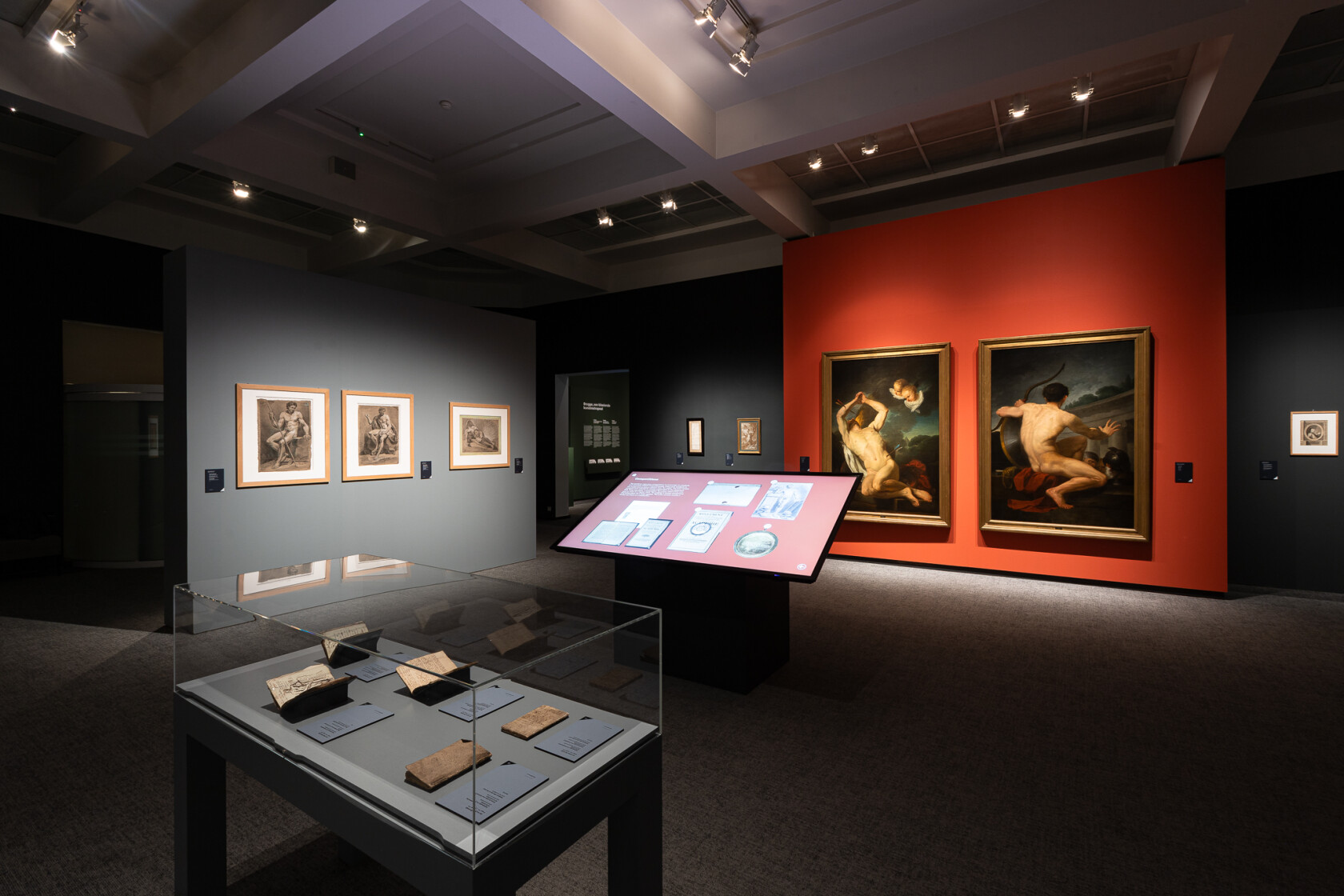
The figure drawings offer a view of the students’ progress. We see them evolve from beginners to more accomplished draughtsmen as they move through the classes. The collection exhibition 'Practice Makes Perfect' (Groeningemuseum, autumn 2023 – spring 2024) placed special focus on four former students of the Bruges Academy in the 18th century. Highlights included figure drawings by Joseph-Benoît Suvée, who took first prize (primus) in drawing from a live model. Several of Garemijn’s notebooks were also exhibited. They were in a display case with a number of drawings made by students during his directorship, making the direct relationships between the objects clear. In addition, visitors could immerse themselves in the Apprentice-Master story via a touchscreen application. In this way, the collection exhibition 'Practice Makes Perfect’ brought the Apprentice-Master I project to wider attention.
Special thanks go to the volunteers of Garemijn Deciphered.
Special thanks also to our partners for helping to achieve this project: Royal Library of Belgium, Brussels (KBR), Royal Academy of Fine Arts, Ghent (KASK), Bruges Academy DKO, VKC and meemoo, City Archives Bruges, the Bruges Public Library, Botanic Garden Meise for managing the ‘DoeDat’ platform, and Royal Museum of Fine Arts Antwerp (KMSKA).
With the support of ERDF & REACT EU


